
The Jeep JK, produced from 2007 to 2018, is a beloved platform for off-road enthusiasts and customization aficionados. Its robust design and readily available aftermarket support make it a blank canvas for personalization. In recent years, 3D printing has emerged as a powerful tool for Jeep JK owners, allowing them to create custom parts tailored to their specific needs and preferences. This article explores the world of Jeep JK custom 3D printed parts, highlighting their benefits, applications, design considerations, and the process involved in bringing your unique ideas to life.
Why 3D Printing for Your Jeep JK?
Jeep JK Custom 3D Printed Parts: Unleashing Personalization and Innovation
Traditional aftermarket parts often come with limitations in terms of design and functionality. 3D printing overcomes these constraints by offering several advantages:
- Unmatched Customization: Create parts that are perfectly tailored to your Jeep JK's specific configuration, modifications, and intended use. No more settling for generic solutions.
- Rapid Prototyping and Iteration: Test different designs and make quick adjustments before committing to a final product. This iterative process ensures optimal fit and functionality.
- Cost-Effectiveness for Small-Batch Production: 3D printing eliminates the need for expensive tooling and molds, making it a cost-effective solution for producing small quantities of custom parts.
- On-Demand Manufacturing: Produce parts only when needed, reducing storage requirements and the risk of obsolescence.
- Material Versatility: 3D printing supports a wide range of materials, including plastics, composites, and even metals, allowing you to choose the best material for your application.

Common Applications of 3D Printed Parts on a Jeep JK
The possibilities for 3D printed parts on a Jeep JK are virtually endless, but here are some popular applications:
- Interior Accessories:
- Phone Mounts: Custom-designed phone mounts that integrate seamlessly with the JK's dashboard or roll cage.
- Switch Panels: Add auxiliary switches for lights, lockers, and other accessories with a clean and professional look.
- Storage Solutions: Create custom storage compartments, organizers, and trays to maximize space and keep your gear secure.
- Gauge Pods: Mount aftermarket gauges in a stylish and functional manner.
- Grab Handles: Design unique grab handles for easier entry and exit.

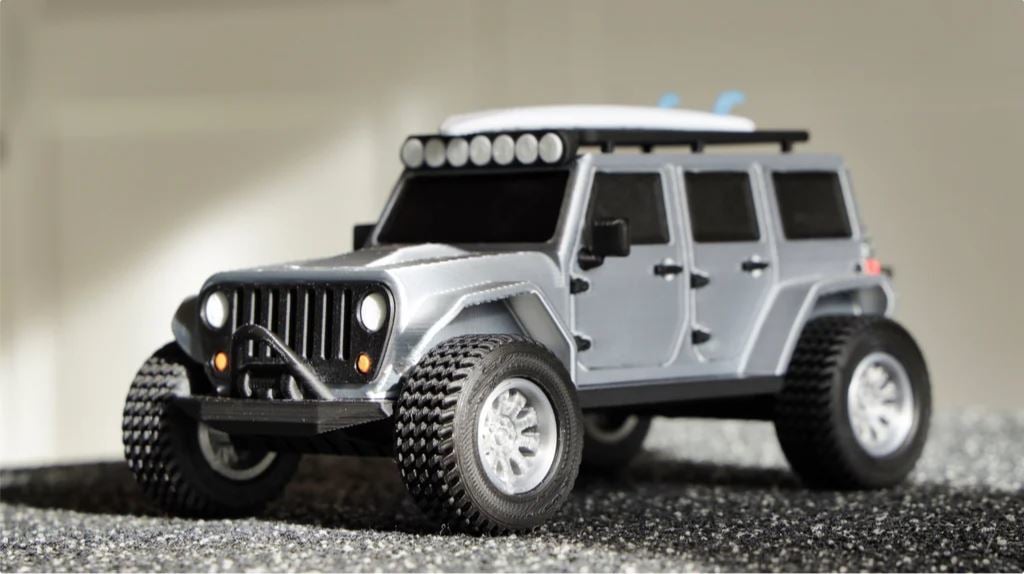
- Exterior Accessories:
- Light Mounts: Design custom light mounts for LED light bars, spotlights, and fog lights.
- Antenna Mounts: Securely mount CB radios or other antennas.
- Body Armor Components: Create custom rock sliders, corner guards, and fender flares. (Material selection is crucial here – reinforced materials are a must).
- Grille Inserts: Add a personalized touch to your Jeep's front grille.
- Hood Vents: Design functional hood vents to improve engine cooling.
- Off-Road Specific Parts:
- Winch Fairleads: Replace or upgrade your winch fairlead with a custom-designed version.
- Hi-Lift Jack Mounts: Securely mount your Hi-Lift jack to your Jeep's roll cage or bumper.
- Locker Actuator Guards: Protect your locker actuators from damage.
- Differential Skid Plates: Add extra protection to your differentials.
- Repair and Replacement Parts:
- Broken Trim Pieces: Recreate damaged or missing trim pieces.
- Knobs and Handles: Replace worn or broken knobs and handles.
- Clips and Fasteners: 3D print custom clips and fasteners to secure various components.
Designing Your 3D Printed Jeep JK Parts: A Step-by-Step Guide
- Identify the Need: Clearly define the purpose and function of the part you want to create. What problem are you trying to solve or what improvement are you trying to make?
- Take Measurements: Accurately measure the area where the part will be installed. Consider clearances, mounting points, and other relevant dimensions.
- Choose a Design Software: Select a 3D modeling software that suits your skill level and needs. Popular options include:
- Tinkercad (Free, Beginner-Friendly): A simple and intuitive online tool for basic 3D modeling.
- Fusion 360 (Free for Hobbyists): A powerful CAD/CAM software with advanced features for creating complex designs.
- SketchUp (Paid, User-Friendly): A popular choice for architectural and product design.
- SolidWorks (Paid, Professional): An industry-standard CAD software for engineers and designers.
- Create the 3D Model: Use the design software to create a 3D model of your part. Pay close attention to details, tolerances, and material properties.
- Consider Material Selection: Choose a 3D printing material that is appropriate for the intended application. Factors to consider include:
- Strength and Durability: How much stress will the part be subjected to?
- Temperature Resistance: Will the part be exposed to high temperatures?
- UV Resistance: Will the part be exposed to sunlight?
- Chemical Resistance: Will the part be exposed to chemicals?
- Flexibility: Does the part need to be flexible or rigid?
- Common 3D printing materials for Jeep JK parts:
- PLA (Polylactic Acid): Easy to print, biodegradable, but not very heat-resistant or durable. Suitable for interior accessories and prototypes.
- ABS (Acrylonitrile Butadiene Styrene): More durable and heat-resistant than PLA, but more difficult to print. Suitable for exterior accessories and some off-road parts.
- PETG (Polyethylene Terephthalate Glycol): A good balance of strength, durability, and ease of printing. Suitable for a wide range of applications.
- Nylon: Very strong and durable, but requires high printing temperatures and specialized equipment. Suitable for demanding applications.
- Carbon Fiber Reinforced Materials: Offer exceptional strength and stiffness, but are more expensive and difficult to print. Suitable for high-performance parts.
- Prepare the Model for Printing: Export the 3D model in STL format and use a slicing software (e.g., Cura, Simplify3D) to prepare it for printing. The slicer converts the 3D model into a series of layers that the 3D printer can understand. Configure printing settings such as layer height, infill density, and support structures.
- Print the Part: Send the sliced file to your 3D printer and start the printing process. Monitor the printing process closely to ensure that the part is being printed correctly.
- Post-Processing: Once the part is printed, remove it from the build plate and perform any necessary post-processing, such as removing support structures, sanding, painting, or applying a protective coating.
- Install and Test: Install the part on your Jeep JK and test its functionality. Make any necessary adjustments or modifications.
Important Considerations and Challenges
- Material Limitations: Not all materials are suitable for all applications. Consider the environmental conditions and stresses that the part will be subjected to.
- Design Complexity: Complex designs may be difficult or impossible to print. Simplify your designs if necessary.
- Printing Time: 3D printing can be a slow process, especially for large or complex parts.
- Dimensional Accuracy: 3D printed parts may not be perfectly dimensionally accurate. Allow for some tolerance in your designs.
- Strength and Durability: 3D printed parts may not be as strong or durable as parts made using traditional manufacturing methods.
- Support Structures: Support structures may be required to print overhanging features. These structures need to be removed after printing.
- Cost: 3D printing can be expensive, especially for large or complex parts.
- Legal and Ethical Considerations: Be aware of any legal or ethical considerations related to 3D printing, such as intellectual property rights.
Tips for Success
- Start Small: Begin with simple projects to gain experience and confidence.
- Research and Experiment: Explore different materials, design techniques, and printing settings.
- Seek Feedback: Share your designs with other Jeep JK enthusiasts and ask for feedback.
- Iterate and Improve: Don't be afraid to make changes and improvements to your designs based on your experience and feedback.
- Document Your Process: Keep track of your design process, printing settings, and post-processing steps.
Pricing Table for Jeep JK Custom 3D Printed Parts
| Part Type | Material | Complexity | Estimated Cost | Notes |
|---|---|---|---|---|
| Phone Mount | PLA | Low | \$10 - \$30 | Simple design, good for prototyping. |
| Switch Panel | ABS | Medium | \$25 - \$50 | More durable, requires accurate dimensions. |
| Storage Compartment | PETG | Medium | \$40 - \$80 | Good balance of strength and ease of printing. |
| Light Mount | ABS/PETG | Medium/High | \$30 - \$75 | Depends on size and complexity. |
| Antenna Mount | PETG | Low/Medium | \$15 - \$40 | Must be sturdy and resistant to vibrations. |
| Rock Slider Component | Nylon/CF | High | \$100+ | Requires advanced materials and printing techniques. |
| Grille Insert | ABS | Medium | \$35 - \$65 | Customizable design. |
| Broken Trim Piece Replacement | ABS/PETG | Low/Medium | \$10 - \$40 | Depends on size and complexity of the original part. |
| Custom Knob/Handle | PLA/ABS | Low | \$5 - \$20 | Easy to customize. |
| Hi-Lift Jack Mount | Nylon/CF | High | \$80+ | Needs to be extremely durable. |
| Differential Skid Plate Component | Nylon/CF | High | \$150+ | Carbon Fiber reinforcement is recommended for high impact resistance |
Note: These prices are estimates and can vary depending on the complexity of the design, the size of the part, the material used, and the printing service you choose. CF = Carbon Fiber
Frequently Asked Questions (FAQ)
- Q: What type of 3D printer do I need to print Jeep JK parts?
- A: A fused deposition modeling (FDM) printer is the most common type of 3D printer used for Jeep JK parts. The printer should have a build volume large enough to accommodate the size of the parts you want to print.
- Q: Where can I find 3D models for Jeep JK parts?
- A: You can find 3D models on websites like Thingiverse, MyMiniFactory, and Cults3D. You can also hire a 3D designer to create custom models for you.
- Q: Can I 3D print load-bearing parts for my Jeep JK?
- A: Yes, but you need to use appropriate materials and printing techniques. Consult with a 3D printing expert to ensure that the parts are strong and durable enough for the intended application. Carbon Fiber reinforced materials are highly recommended for load-bearing applications.
- Q: How much does it cost to 3D print a Jeep JK part?
- A: The cost depends on the size of the part, the material used, the complexity of the design, and the printing service you choose. Get quotes from multiple 3D printing services to compare prices.
- Q: Is 3D printing durable enough for off-road use?
- A: Yes, with the right materials and design, 3D printed parts can be durable enough for off-road use. Consider using materials like ABS, PETG, Nylon, or carbon fiber reinforced composites.
Conclusion
3D printing has revolutionized the world of Jeep JK customization, offering unparalleled opportunities for personalization, innovation, and problem-solving. By understanding the principles of 3D printing, material selection, and design considerations, Jeep JK owners can create custom parts that enhance their vehicle's functionality, appearance, and performance. While challenges exist, the benefits of 3D printing far outweigh the drawbacks, making it an indispensable tool for any serious Jeep JK enthusiast. As 3D printing technology continues to evolve, we can expect to see even more exciting and innovative applications for Jeep JK customization in the future.